Rolling mill bearings play a critical role in maintaining roll stability, controlling strip thickness and ensuring continuous production in steel and metal processing plants. Work rolls and backup rolls operate under different loading conditions and have different bearing requirements. Selecting the correct bearing arrangement requires more than matching the shaft diameter and housing dimensions.
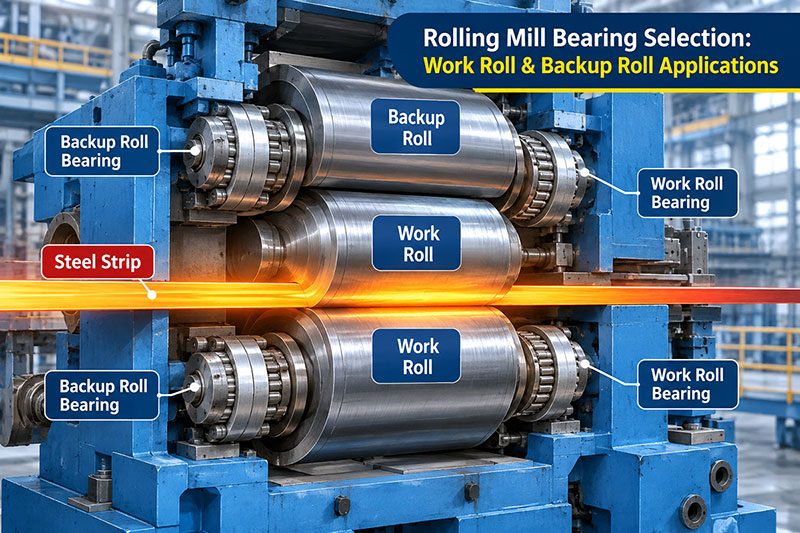
This guide explains the differences between work roll bearings and backup roll bearings, reviews commonly used bearing types, and outlines the main technical factors to consider when selecting or replacing rolling mill bearings.
1. Understanding Work Roll and Backup Roll Applications
In a typical four-high rolling mill, the work rolls directly contact the metal being processed, while the larger backup rolls support the work rolls and help resist the rolling force. Although both roll positions are exposed to heavy loads, their operating conditions and bearing arrangements are not necessarily the same.
Work Roll Bearings
Work rolls directly contact the steel strip, plate or other metal material. Their bearings must accommodate the loads generated during rolling, rotational speed, axial forces and frequent changes in operating conditions.
- High radial and, where applicable, axial load capacity
- Stable operation at the required rolling speed
- Good rotational accuracy
- Resistance to water, scale and contamination
- Convenient inspection and maintenance
Backup Roll Bearings
Backup rolls support the work rolls and carry substantial radial loads transmitted through the roll assembly. Bearing rigidity and load distribution are particularly important for maintaining roll alignment and consistent product quality.
- Very high radial load capacity
- High radial rigidity
- Reliable operation under continuous heavy loads
- Controlled internal clearance
- Suitable lubrication and sealing arrangements
2. Common Bearing Types Used for Rolling Mill Rolls
Different rolling mill designs require different bearing arrangements. The choice depends on the mill configuration, roll dimensions, load direction, speed and available installation space.
2.1 Four-Row Tapered Roller Bearings for Work Rolls
Four-row tapered roller bearings are widely used in rolling mill work roll applications, particularly where the bearing must accommodate heavy radial loads together with axial forces.
The tapered roller arrangement provides high load capacity and can support combined radial and axial loads. Depending on the design, the bearing can accommodate axial forces in both directions as part of the complete bearing arrangement.
- High radial and axial load-carrying capacity
- Suitable for demanding rolling mill conditions
- Compact arrangement for heavily loaded roll necks
- Separable components for convenient mounting and maintenance
These bearings are commonly considered for work rolls in hot strip mills, cold rolling mills, plate mills and other metal rolling equipment. Actual suitability should be confirmed against the original bearing arrangement and operating conditions.
Read more about four-row tapered roller bearings used in rolling mills.
2.2 Four-Row Cylindrical Roller Bearings for Backup Rolls
Four-row cylindrical roller bearings are a common solution for heavily loaded backup roll positions. Their multiple rows of cylindrical rollers provide a large radial load-carrying area and high radial rigidity.
These bearings are particularly suitable for applications where high radial load capacity is the primary requirement. Depending on the mill design, axial loads are accommodated by separate thrust bearings or other locating arrangements.
- Very high radial load capacity
- High radial stiffness for roll support
- Suitable for continuous heavy-duty operation
- Separable construction for easier installation and removal
- Available in different internal designs and dimensional configurations
FC, FCD and FCDP are common design groups of four-row cylindrical roller bearings used in rolling mill applications. Their internal construction and component arrangements differ, so they should not be considered interchangeable based on dimensions alone.
For a more detailed comparison, see How to Choose FC, FCD or FCDP Four-Row Cylindrical Roller Bearings.
2.3 Backing Bearings for Multi-Roll Mills
Backing bearings serve a different function from conventional work roll and backup roll neck bearings. They are specialized support bearings used in multi-roll rolling mills, particularly 12-high and 20-high Sendzimir mills.
In these machines, multiple backing bearings support intermediate rolls and help distribute the rolling force throughout the roll assembly. The outer ring usually acts as the working contact surface, making its dimensional accuracy and surface quality particularly important.
Important requirements include:
- High dimensional and running accuracy
- Controlled outer ring diameter and roundness
- Consistent bearing height and T-value
- Matched bearing sets where required
- Suitable precision grades and internal configurations
Backing bearings are not simply replacements for conventional four-row cylindrical roller bearings. Their installation arrangement and operating principles are different.
Explore our backing bearings and backing bearing manufacturing and T-value control.
3. Work Roll Bearings vs. Backup Roll Bearings
The following table summarizes the typical differences between these two applications. The bearing type shown is a general reference rather than a universal rule for every rolling mill.
| Item | Work Roll Position | Backup Roll Position |
|---|---|---|
| Primary function | Contacts and deforms the metal being rolled | Supports work rolls and transfers rolling forces |
| Main loading | Heavy radial loads and possible axial loads | Very heavy radial loads |
| Typical bearing type | Four-row tapered or cylindrical roller bearings, depending on the mill design | Four-row cylindrical roller bearings, often with a separate thrust bearing arrangement |
| Key requirement | Combined load capacity, speed and rotational accuracy | Radial load capacity and rigidity |
| Selection priority | Load direction, speed, axial location and roll neck dimensions | Radial load, deflection control, clearance and lubrication |
4. Key Factors in Rolling Mill Bearing Selection
Choosing the correct bearing requires evaluating the complete operating environment rather than relying on a bearing series or nominal dimensions alone.
4.1 Radial and Axial Loads
Determine the radial load acting on each roll position and identify whether axial forces are present. Reversing mills, rolling force fluctuations and changes in material thickness can produce additional loading that should be included in the bearing assessment.
Four-row cylindrical roller bearings are generally selected for high radial load applications, while tapered roller bearings can accommodate combined radial and axial loads. The complete bearing arrangement must be checked to ensure that all applied forces are properly supported.
4.2 Operating Speed and Temperature
Work rolls and backup rolls may operate at different speeds depending on the mill configuration. Bearing selection should consider rotational speed, friction, heat generation, operating temperature and the lubrication system.
High-speed applications require particular attention to cage design, lubricant supply and heat dissipation. Low-speed, heavily loaded applications may require a different internal design and lubrication strategy.
4.3 Internal Clearance and Precision
Internal clearance influences bearing operating temperature, load distribution and service life. The appropriate clearance depends on fits, operating temperature, shaft and housing deformation, and the bearing’s internal design.
Precision requirements are also important in rolling mills because bearing accuracy affects roll positioning and the stability of the rolling process. The required tolerance class should be confirmed from the equipment specification or original bearing documentation.
4.4 Lubrication and Contamination Protection
Rolling mill bearings are often exposed to water, cooling fluid, metal scale, dust and other contaminants. Inadequate lubrication or contamination can lead to premature wear, surface damage and bearing failure.
The lubrication method, lubricant viscosity, supply rate, sealing arrangement and maintenance intervals should be selected according to the actual operating conditions.
4.5 Installation Space and Mounting Requirements
Roll neck diameter, housing dimensions, shoulder geometry and available axial space determine which bearing designs can be installed. Separable bearing components can make mounting and roll changes easier, but the installation sequence and component matching must follow the bearing design requirements.
5. Bearing Replacement: What Information Should Be Confirmed?
When replacing a rolling mill bearing, using the original bearing number is the most reliable starting point. However, a replacement should not be selected solely because its main dimensions are identical.
Before requesting a quotation or evaluating an alternative bearing, prepare the following information:
Rolling Mill Bearing Replacement Checklist
- Original bearing designation and manufacturer
- Inner diameter, outer diameter and total width (d × D × B)
- Work roll or backup roll application
- Roll neck and housing drawings
- Radial and axial load conditions
- Operating speed and temperature
- Internal clearance and precision requirements
- Cage material and internal design
- Lubrication and sealing arrangement
- Special requirements for mounting or matched sets
If the original model is unavailable, dimensional drawings, photographs and operating information can help determine a suitable replacement. For customized bearings, the complete internal design and manufacturing requirements should also be evaluated.
6. Rolling Mill Bearing Manufacturing and Customization
JYHY Group supplies industrial bearings for steel mills, metallurgical equipment and other heavy-duty applications. Our rolling mill bearing range covers different bearing designs for work rolls, backup rolls and multi-roll mill assemblies.
Our product and manufacturing capabilities include:
- Four-row tapered roller bearings for rolling mill applications
- FC, FCD and FCDP four-row cylindrical roller bearings
- Double-row and triple-row cylindrical roller backing bearings
- Large-size and non-standard bearing solutions
- OEM manufacturing according to customer drawings and technical specifications
We can evaluate replacement and customized bearing requirements based on original bearing numbers, dimensional drawings and actual operating conditions. For non-standard applications, our technical team can review the required dimensions, internal construction, materials, precision and clearance before production.
Visit our steel mill bearing applications page to learn more about bearing solutions for steel production equipment.
7. Frequently Asked Questions
What is the difference between work roll bearings and backup roll bearings?
Work roll bearings support rolls that directly contact the metal being processed. Backup roll bearings support the work rolls and carry the forces transmitted through the roll assembly. Their load conditions and bearing arrangements vary with the mill design.
Which bearings are commonly used for rolling mill work rolls?
Four-row tapered roller bearings and four-row cylindrical roller bearings are both used in work roll applications. The appropriate choice depends on radial and axial loads, rolling speed, mill configuration and the original bearing arrangement.
Why are four-row cylindrical roller bearings used for backup rolls?
Their multiple rows of cylindrical rollers provide high radial load capacity and rigidity, making them suitable for heavily loaded backup roll positions. Axial loads are generally handled by a separate thrust bearing or locating arrangement where required.
Can a four-row cylindrical roller bearing replace a four-row tapered roller bearing?
Not necessarily. The two designs have different load-carrying characteristics and axial locating capabilities. Any replacement must be evaluated against the complete bearing arrangement, applied loads, mounting dimensions and equipment requirements.
Can JYHY manufacture non-standard rolling mill bearings?
Yes. JYHY can evaluate OEM and non-standard bearing requirements according to customer drawings, original bearing specifications and application conditions. Customized dimensions and internal designs should be confirmed through technical review.