Quick Answer
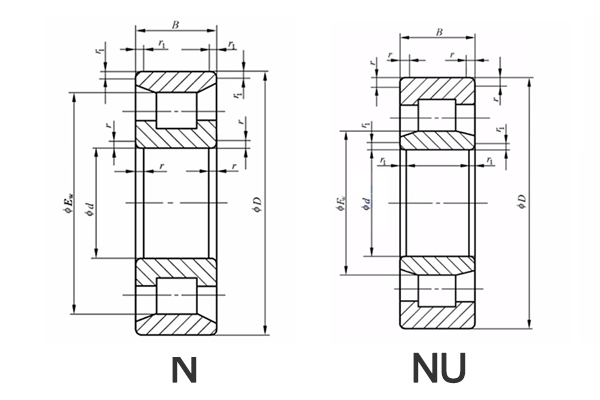
- N bearing: inner ring has two integral flanges, outer ring has no flange — the outer ring can move axially (housing side floats).
- NU bearing: outer ring has two integral flanges, inner ring has no flange — the inner ring / shaft can move axially (shaft side floats).
- Rule of thumb: if you need a floating bearing, NU is the default choice. N is the special case — choose it only when the housing, not the shaft, must accommodate axial displacement.
Structural Difference: Which Ring Floats?
Both designs are pure radial bearings with cylindrical rollers. The only structural difference is where the locating flanges sit — and that decides which ring is free to move axially.
| Feature | N Bearing | NU Bearing |
|---|---|---|
| Inner ring flanges | Two integral flanges | No flange |
| Outer ring flanges | No flange | Two integral flanges |
| Axial float side | Outer ring floats (housing side) | Inner ring floats (shaft side) |
| Thermal expansion absorbed | Housing / outer ring movement | Shaft growth along the roller raceway |
| Axial location capability | None (pure radial) | None (pure radial) |
| Typical use | Special arrangements where the housing must slide | Standard floating position in most machines |
Neither N nor NU can locate the shaft axially. If you need axial location, look at NJ and NUP designs — our NU vs NJ guide covers the locating end in detail.
What an N Bearing Does
The N design has two flanges on the inner ring (which guide the rollers) and no flange on the outer ring. The outer ring can therefore slide axially in the housing bore, absorbing axial displacement between the housing and the shaft.
- Housing-side float: the movement happens between the outer ring and the housing bore.
- Shaft can be tightly located: because axial location is handled by other bearings on the shaft, the N bearing can take an interference fit on the shaft without blocking expansion.
- Rare but real: used mainly in designs where the shaft is axially fixed elsewhere and the housing must be free to expand or move.
Watch out: housing-side sliding surfaces are prone to fretting corrosion if the sliding contact is not properly lubricated and machined. This is the main reason N is specified far less often than NU.
What an NU Bearing Does
The NU design puts two flanges on the outer ring, leaving the inner ring free. The shaft (with the inner ring) expands or contracts along the roller raceway — the classic floating behaviour for a rotating shaft.
- Shaft-side float: thermal growth of the shaft is absorbed between the rollers and the raceway, not in the housing.
- Tight shaft fit is fine: the inner ring can be press-fitted; axial movement happens on the roller contact, so no sliding surface in the housing is needed.
- The industry default: motors, gearboxes, pumps, compressors, rolling mills and long drive shafts all use NU as the standard floating bearing.
N vs NU: Full Comparison
| Item | N Bearing | NU Bearing |
|---|---|---|
| Boundary dimensions | ISO 15, same as NU of the same size | ISO 15 |
| Radial load capacity | High (same as NU for the same size) | High |
| Axial load capacity | None | None |
| Floating ring | Outer ring | Inner ring |
| Shaft fit | Can be tight (location handled elsewhere) | Can be tight — float occurs on rollers |
| Housing fit | Must allow axial sliding (clearance fit + smooth bore) | Normal fits; no sliding in the bore |
| Fretting risk | Higher, at the housing contact | Low at housing; standard practice |
| Availability | Produced on request / less common | Widely stocked, standard production |
| Typical applications | Special transmissions, housing-expansion designs | Motors, gearboxes, mills, pumps, compressors |
Radial internal clearance groups (C2–C4), precision classes (P0–P5) and cage options (machined brass, pressed steel, polyamide) apply to both designs equally.
How to Choose: N or NU?
Choose NU when…
- The shaft expands with temperature and must float axially (most machines).
- You want a tight press fit on the shaft and no sliding surface in the housing bore.
- You want the standard, widely available floating bearing with normal lead times.
Choose N when…
- The shaft is axially located by other bearings and the housing must be free to move or expand.
- The housing bore can be machined as a smooth, lubricated sliding seat (split housings help).
- You have verified that the housing-side sliding contact will not develop fretting in your duty cycle.
Not sure which ring should float? Send us your shaft and housing arrangement — we will confirm the correct bearing design and fits.
Where N and NU Fit in an Arrangement
Every shaft arrangement needs at least one locating bearing (axial location) and normally one floating bearing (thermal compensation):
- Locating end: NUP (two-direction) or NJ (one-direction) — see our NU vs NJ bearing guide.
- Floating end: NU by default; N only in the special housing-floating cases above.
- For very long shafts or high temperature gradients, confirm the required axial float before ordering — the displacement is limited by the effective roller contact length.
FAQ
Q: Can an N bearing replace an NU bearing?
A: Not directly. They have the same dimensions but float on opposite rings. Substituting N for NU usually forces the housing to slide, which most existing housings are not machined for.
Q: Why is NU so much more common than N?
A: Because in most machines the shaft expands and rotates. NU absorbs the growth on the roller raceway without needing a sliding surface in the housing — simpler, more reliable, and less prone to fretting.
Q: Can N or NU bearings take axial loads?
A: No. Both are pure radial designs. Use NJ or NUP when axial location is required.
Q: What is the difference between N and NJ?
A: N has no locating function (the outer ring floats); NJ has one locating flange on the inner ring and locates the shaft in one direction.
Q: When is an N bearing actually used in industry?
A: In designs where the shaft is axially fixed by other bearings and the housing must accommodate expansion — for example certain gearbox and transmission layouts with split housings.
Q: What clearance should a floating N or NU bearing have?
A: Standard CN (C0) for normal duty; C3 or C4 for high temperature or vibrating applications. Specify the group when ordering.
Q: How do I order N or NU bearings from JYHY?
A: Send the size series and bore (e.g. N 220, NU 220), precision class, radial clearance and cage preference with your speed / temperature condition. We confirm the full designation and quote within one working day.
Related Reading
Why JYHY Group
JYHY Group is an industrial bearing manufacturer based in Wafangdian, China, specialising in medium & large bearings from 100 to 2000 mm outer diameter — including N, NU, NJ and NUP single-row cylindrical roller bearings, FC / FCD four-row designs and spherical roller bearings.
- Direct factory production, full traceability
- Custom sizes, precision classes, clearances and cages
- Arrangement and fit consultation with application drawings
- 30% deposit, balance before shipment — a reliable long-term partner