Quick Answer
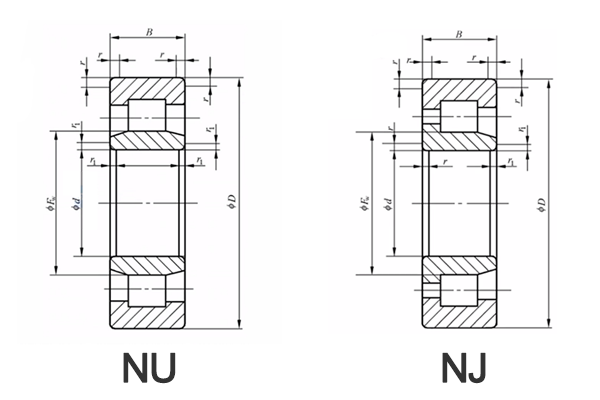
- NU bearing: outer ring has two integral flanges, inner ring has no flange — the shaft can move axially in both directions (floating end).
- NJ bearing: outer ring has two integral flanges, inner ring has one locating flange — it locates the shaft in one direction and can take moderate one-direction axial loads (locating end).
- Same size series of NU and NJ share the same boundary dimensions and essentially the same radial load ratings — the difference is axial behavior, not radial capacity.
NU vs NJ: Structural Difference
The key difference is the flange layout of the inner ring. The outer ring of both types carries two integral flanges; it is the inner ring that decides whether the bearing floats or locates.
| Feature | NU Bearing | NJ Bearing |
|---|---|---|
| Outer ring flanges | Two integral flanges | Two integral flanges |
| Inner ring flanges | No locating flange | One locating flange (single direction) |
| Axial positioning | Free axial movement, both directions | Axial location in one direction |
| Axial load support | None (pure radial) | Moderate axial load in one direction |
| Shaft thermal expansion | Fully compensated | Partially restricted |
| Typical position in arrangement | Floating end | Locating / semi-locating end |
| Typical applications | Electric motors, rolling mills, long shafts | Gearboxes, drives, positioning systems |
If a locating (fixed) end must be positioned in both directions, use an NUP bearing, or add an HJ loose rib to an NJ bearing.
Full Family Comparison: N / NU / NJ / NUP
All four are single-row cylindrical roller bearings. Only the flange combination changes — and with it, the axial function.
| Design | Inner ring | Outer ring | Axial function | Use as |
|---|---|---|---|---|
| N | Two flanges | No flange | Outer ring can move axially | Floating end |
| NU | No flange | Two flanges | Inner ring (shaft) can move axially | Floating end |
| NJ | One flange | Two flanges | Locates shaft in one direction | Locating end |
| NUP | One flange + loose rib | Two flanges | Locates shaft in both directions | Fixed (locating) end |
Cylindrical roller bearings carry high radial loads but cannot accommodate angular misalignment. If the shaft deflects or the housings misalign, a spherical roller bearing is the better choice — contact our team for a cross-type comparison.
Cylindrical roller bearings carry high radial loads but cannot accommodate angular misalignment. If the shaft deflects or the housings misalign, a spherical roller bearing is the better choice — contact our team for a cross-type comparison. Learn more about the floating designs: N series bearings (outer ring floating) and NU series bearings (inner ring floating).
Sizes, Precision, Clearance and Cages
NU and NJ are manufactured to ISO 15 boundary dimensions across a wide range of size series.
| Item | Common range / grades | Notes |
|---|---|---|
| Size series | 10, 19, 2, 3, 22, 23 | 22 / 23 are wide series with higher load capacity |
| Bore / O.D. range | From ~20 mm bore up to several hundred mm; custom up to 100–2000 mm O.D. | JYHY specialises in medium & large industrial bearings |
| Radial internal clearance | C2, CN (C0), C3, C4 | Select C3 / C4 for thermal or vibrating duty |
| Tolerance (precision) class | P0, P6, P5 (higher on request) | Choose P5 / P4 for high-speed spindles |
| Cage type | Machined brass, pressed steel, polyamide | Machined brass for high speed; polyamide for light/medium duty |
Why the cage matters for your application
- Machined brass cage: best high-speed performance and dimensional stability — recommended for compressors, pumps and continuous running gearboxes.
- Pressed steel cage: cost-effective, robust at high temperature — common in standard industrial duty.
- Polyamide cage: light and self-lubricating — used in smaller sizes and moderate speeds.
How to Choose NU vs NJ by Working Condition
Rolling mills
Work rolls typically use four-row cylindrical roller bearings (FC / FCD series); for back-up roll and drive arrangements use NU at the floating end to absorb thermal expansion from rolling heat, and NJ / NUP at the locating end. Choose C3/C4 clearance for hot rolling lines.
Gearboxes
Locating the pinion or output shaft with NJ (moderate one-direction axial load) and floating the opposite end with NU is the standard arrangement. Add an HJ loose rib if two-direction location is required.
Electric motors
NU on the drive end compensates shaft expansion from operating temperature; a deep groove ball bearing or NJ takes the locating function at the non-drive end.
Vibrating screens & crushers
High vibration and thermal cycling demand larger internal clearance — use NU / NJ with C3–C4 clearance and machined brass cages for reliability under continuous shock loads.
Compressors & pumps
Higher speeds call for P5 precision, machined brass cages and proper oil lubrication — NU floating / NJ locating keeps shaft expansion under control without over-constraining.
Machine tool spindles
Use high-precision (P5/P4) NU bearings with matched clearance for the floating end; pair with an angular contact bearing set for the locating end.
Typical Bearing Arrangement: Locating + Floating
Most heavy industrial shafts use one locating end and one floating end so the shaft can expand without binding:
- Locating end: NUP bearing (two-direction), or NJ + HJ rib — positions the shaft and takes axial loads.
- Floating end: NU bearing — allows free axial displacement, takes only radial load.
- If axial loads act in both directions, combine NJ with a thrust bearing or use an NUP design instead of forcing a single NJ.
FAQ
Q: What is the main difference between NU and NJ bearings?
A: Axial positioning. NU allows the shaft to move axially in both directions (floating), while NJ locates the shaft in one direction and can carry moderate one-direction axial load.
Q: Can an NJ bearing replace an NU bearing?
A: Not directly. They have the same boundary dimensions but different flange arrangements. The right choice depends on whether your arrangement needs free expansion (NU) or one-direction location (NJ).
Q: Which bearing is better for shaft thermal expansion?
A: NU. With no locating flange on the inner ring, the shaft can expand freely without creating axial preload inside the bearing.
Q: Do NJ bearings support axial loads?
A: Yes — moderate axial loads in one direction, while keeping full radial load capacity.
Q: What is an NUP bearing for?
A: NUP has one flange plus a loose rib on the inner ring, so it locates the shaft in both directions — the typical choice for a fixed end in a locating/floating arrangement.
Q: What clearance should I order for hot or vibrating duty?
A: C3 or C4. Larger clearance gives the bearing room to expand under heat and survive vibration without losing the internal geometry.
Q: How do I specify NU/NJ bearings when ordering?
A: Give us: size series and bore (e.g. NU 220 / NJ 320), required precision class (P0–P5), radial clearance (C2–C4), cage type, and your speed / lubrication condition. We will confirm the full designation and price.
Q: NU/NJ or spherical roller bearing — which one?
A: Pure high radial load with controlled shaft position → NU/NJ/NUP. Shaft deflection, misalignment or combined radial + axial load → spherical roller bearing. Tell us your housing and load condition and we will recommend the right type.
Why JYHY Group
JYHY Group is an industrial bearing manufacturer based in Wafangdian, China, specialising in medium & large bearings from 100 to 2000 mm outer diameter, including NU / NJ cylindrical roller bearings, FC / FCD four-row cylindrical roller bearings and spherical roller bearings.
- Direct factory production — no middleman, full-traceability
- Custom sizes, precision classes, clearances and cages on request
- Technical support with application drawings and selection assistance
- 30% deposit, balance before shipment — a reliable long-term partner for global buyers