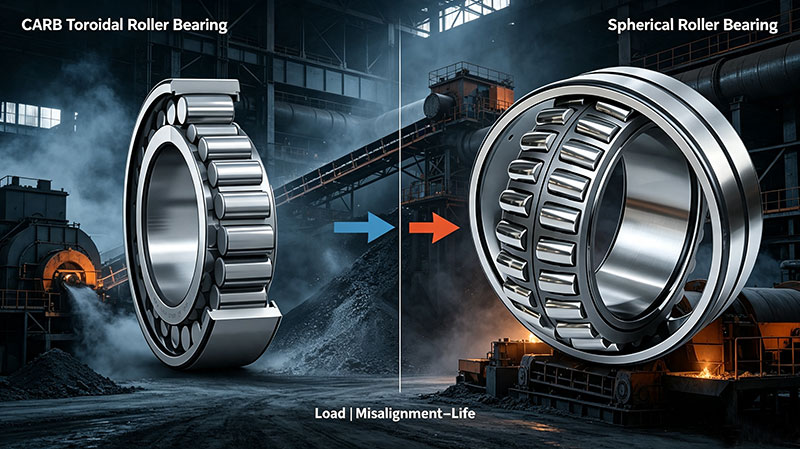
CARB bearings and spherical roller bearings are both self-aligning roller bearings designed for heavy industrial applications. They can accommodate shaft misalignment and provide high radial load capacity, but their internal designs and operating advantages are different.
Choosing between CARB bearings and spherical roller bearings depends on application requirements such as axial displacement, radial load, available installation space, and operating conditions.
JYHY Group supplies industrial bearing solutions including CARB toroidal roller bearings and spherical roller bearings for mining, steel, cement, and heavy machinery applications.
What Are CARB Bearings?
CARB bearings, also known as toroidal roller bearings, are a type of self-aligning roller bearing developed to combine the advantages of spherical roller bearings and cylindrical roller bearings.
Their unique toroidal roller design allows them to accommodate both angular misalignment and axial displacement without generating additional internal stress.
- Self-aligning capability: Compensates for shaft and housing misalignment.
- Axial displacement capability: Allows axial movement inside the bearing.
- High radial load capacity: Suitable for demanding industrial applications.
What Are Spherical Roller Bearings?
Spherical roller bearings are widely used heavy-duty bearings designed to support large radial loads and combined radial and axial loads.
They contain barrel-shaped rollers arranged in two rows with a spherical outer ring raceway, allowing the bearing to compensate for misalignment during operation.
- High load capacity: Suitable for heavy machinery and shock loads.
- Excellent misalignment compensation: Handles shaft deflection and mounting errors.
- Combined load capability: Supports both radial and axial loads.
CARB Bearings vs Spherical Roller Bearings: Main Differences
| Feature | CARB Bearings | Spherical Roller Bearings |
|---|---|---|
| Bearing Type | Toroidal roller bearing with single row rollers | Double row spherical roller bearing |
| Misalignment Capability | Excellent self-aligning capability | Excellent self-aligning capability |
| Axial Displacement | Allows axial displacement inside bearing | Limited axial displacement capability |
| Radial Load Capacity | High | Very high |
| Axial Load Support | Limited axial load capability | Supports combined loads |
| Main Advantage | Handles misalignment and shaft expansion simultaneously | Maximum load capacity in heavy-duty applications |
CARB Bearings vs Spherical Roller Bearings Working Principle
The main difference comes from roller geometry and internal design.
In CARB bearings, the toroidal rollers and raceways allow the rollers to move axially while maintaining proper contact. This reduces internal stress caused by shaft expansion.
Spherical roller bearings use two rows of barrel rollers to achieve extremely high load carrying capacity. They are designed mainly for heavy radial loads and combined loading conditions.
Advantages of CARB Bearings
- Compensates for shaft expansion: Suitable for long shafts exposed to temperature changes.
- Reduces internal stress: Allows axial movement without additional bearing load.
- Improves bearing life: Reduces edge loading caused by displacement.
- Compact bearing arrangements: Can simplify locating and floating bearing designs.
Advantages of Spherical Roller Bearings
- Higher load capacity: Designed for extremely heavy radial and shock loads.
- Combined load support: Handles radial and axial loads simultaneously.
- Wide application range: Used in mining, construction, steel, and power industries.
- Reliable operation: Suitable for harsh industrial environments.
Applications Comparison
| Application | Recommended Bearing | Reason |
|---|---|---|
| Continuous conveyor systems | CARB Bearings | Handles shaft expansion and misalignment effectively |
| Mining equipment | Spherical Roller Bearings | Requires very high load capacity and shock resistance |
| Steel mill equipment | Both | Selection depends on shaft movement and load conditions |
| Cement machinery | Both | Depends on operating temperature and bearing arrangement |
How to Choose Between CARB and Spherical Roller Bearings?
The correct bearing selection depends on the machine design and operating requirements.
- Choose CARB bearings when: the shaft requires both misalignment compensation and axial displacement capability.
- Choose spherical roller bearings when: maximum load capacity and combined load support are required.
- Consider operating conditions: including speed, temperature, lubrication, and maintenance requirements.
CARB and Spherical Roller Bearings in Industrial Applications
Both bearing types are widely used in heavy industries:
- Mining equipment
- Steel mills
- Cement plants
- Conveyor systems
- Paper machinery
- Power generation equipment
- Gear drives
- Heavy rotating machinery
Conclusion
CARB bearings and spherical roller bearings both provide excellent self-aligning performance, but they are designed for different requirements.
CARB bearings are ideal when axial displacement and misalignment compensation are important, while spherical roller bearings are preferred for applications requiring maximum load capacity and combined load support.
Selecting the correct bearing type helps improve equipment reliability, reduce maintenance costs, and extend service life.
FAQ
What is the difference between CARB bearings and spherical roller bearings?
CARB bearings allow axial displacement while maintaining self-alignment, whereas spherical roller bearings provide higher load capacity and combined load support.
Are CARB bearings self-aligning?
Yes. CARB bearings are designed to compensate for shaft and housing misalignment.
Can CARB bearings replace spherical roller bearings?
In some applications yes, but the selection depends on load requirements, axial movement, and bearing arrangement.
Where are CARB bearings used?
CARB bearings are commonly used in conveyors, industrial machinery, paper equipment, mining systems, and applications with shaft expansion.
Need help selecting the right bearing? Explore our CARB bearing catalog or contact our technical team for industrial bearing solutions.