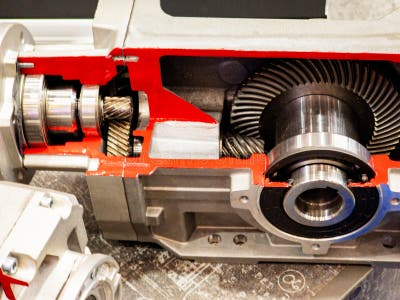
Industrial reducers and gearboxes are used in a wide range of heavy-duty machinery to reduce rotational speed and transmit high torque. As the size and power of the gearbox increase, the bearings inside the reducer must withstand higher radial loads, axial loads, shock loads and continuous operating conditions.
For large industrial gearboxes, large reducer bearings are an important part of the transmission system. Depending on the gearbox design and bearing position, cylindrical roller bearings, spherical roller bearings, tapered roller bearings and thrust roller bearings may be used.
For industrial gearbox and reducer applications, JYHY supplies large reducer bearings for heavy-duty transmission systems, including standard, replacement and customized bearing solutions.
JYHY Group manufactures medium and large industrial bearings for heavy-duty machinery, including large-bore and customized bearings for industrial transmission applications.
What Are Reducer Bearings?
Reducer bearings are rolling bearings installed inside industrial reducers and gearboxes to support shafts, gears, planetary gears and other rotating components.
The bearings must maintain accurate shaft positioning while allowing the transmission components to rotate under load. In heavy-duty gearboxes, the operating conditions can include high radial loads, combined radial and axial loads, impact loads, vibration and temperature changes.
For this reason, selecting a reducer bearing requires more than simply matching the bearing bore to the shaft diameter. Load, speed, clearance, lubrication, mounting conditions and shaft or housing alignment should also be considered.
Why Large Reducers Require Heavy-Duty Bearings
Large industrial reducers transmit high torque through large gears and shafts. The bearings supporting these components must provide sufficient load capacity and reliable operation throughout the gearbox service life.
High Radial Loads
Large gears and shafts can generate substantial radial forces during operation. Bearings with high radial load capacity are therefore commonly required in heavy-duty gearbox applications.
Cylindrical roller bearings are often considered where high radial load capacity is the primary requirement. Their design allows them to support substantial radial loads while maintaining a relatively compact radial section.
Combined Radial and Axial Loads
Some gearbox shafts are subjected to both radial and axial forces.
Depending on the bearing arrangement, tapered roller bearings, spherical roller bearings or thrust bearings may be selected to accommodate these loads.
The actual bearing arrangement depends on the gearbox design, load direction and required axial positioning.
Shock Loads and Vibration
Reducers used in mining, steel production, cement plants and other heavy industries can experience fluctuating loads, vibration and shock loading.
A suitable reducer bearing should therefore be selected according to the actual operating conditions rather than based only on static dimensions.
Continuous Operation
Industrial gearboxes often operate for long production cycles. Bearing performance can directly affect gearbox reliability and maintenance requirements.
Proper lubrication, bearing clearance, shaft and housing fits, installation accuracy and operating temperature are important considerations for large reducer bearings.
Bearing Types Used in Large Industrial Reducers
Different locations inside a reducer can require different bearing designs. The appropriate bearing type depends on the load and function of each shaft or gear position.
Large Cylindrical Roller Bearings
Cylindrical roller bearings are widely used in industrial transmission systems where high radial load capacity is required.
They can be used for gearbox shafts and other rotating components subjected primarily to radial loads.
For large reducers, possible configurations include:
- Single-row cylindrical roller bearings
- Double-row cylindrical roller bearings
- Multi-row cylindrical roller bearings
- Full-complement cylindrical roller bearings
- Customized cylindrical roller bearings
Large cylindrical roller bearings can also be considered for planetary gearbox applications where high radial load capacity is required within a limited installation space.
For heavy-duty transmission equipment, the bearing configuration should be selected according to the actual load, speed, available space and mounting arrangement.
Large Spherical Roller Bearings
Spherical roller bearings are suitable for applications requiring high radial load capacity together with the ability to accommodate misalignment.
This can be useful in large industrial machinery where shaft deflection, housing deformation or alignment changes may occur during operation.
Spherical roller bearings can be used in industrial transmission equipment, heavy machinery, mining equipment and other demanding applications.
JYHY supplies large spherical roller bearings in a wide range of series and sizes, including 230 series, 231, 232, 240 and 241 series.
For large reducer applications, the appropriate model should be determined according to the shaft diameter, housing dimensions, radial and axial loads, operating speed and lubrication conditions.
Large Tapered Roller Bearings
Tapered roller bearings are designed to support both radial and axial loads.
They can be considered for reducer shaft positions where axial positioning is required together with radial load support.
Large tapered roller bearings may also be arranged in pairs depending on the gearbox design and the direction of the applied axial load.
Thrust Roller Bearings
Some large reducers generate substantial axial forces. In these cases, a dedicated thrust bearing arrangement may be required.
Thrust roller bearings can support axial loads and are used in various heavy-duty industrial transmission systems.
The appropriate thrust bearing type depends on the magnitude and direction of the axial load, rotational speed and gearbox construction.
Large Reducer Bearings for Planetary Gearboxes
Planetary gearboxes are widely used when high torque transmission and compact construction are required.
Their internal bearing arrangements can be particularly demanding because planetary gears rotate around the central axis while transmitting high loads.
Bearings may be installed inside planetary gears, on planetary pins, or in other shaft-support positions.
Cylindrical roller bearings are commonly considered for planetary gear applications because of their high radial load capacity and compact radial design.
For large planetary reducers, bearing selection should take into account:
- Planetary gear dimensions
- Planet pin diameter
- Radial load
- Rotational speed
- Gear load distribution
- Installation space
- Lubrication method
- Operating temperature
Special or customized bearings may be required when standard bearing dimensions cannot meet the requirements of the planetary gearbox.
Reducer Bearings for Rolling Mill Gearboxes
Rolling mills use large gearboxes and transmission systems to transfer high torque to the rolls.
The operating environment can involve high loads, vibration, shock loading and continuous production. Bearing reliability is therefore an important consideration for rolling mill gearbox applications.
Depending on the gearbox structure, cylindrical roller bearings, spherical roller bearings and tapered roller bearings may be used.
Large bearing requirements for rolling mill gearboxes can include:
- High radial load capacity
- High load carrying capability
- Resistance to vibration and shock
- Controlled internal clearance
- High dimensional accuracy
- Suitable cage design
- Reliable lubrication
- Long operating life
For replacement projects, the original bearing number and gearbox drawing can be used to determine the required bearing dimensions and internal configuration.
Reducer Bearings for Cement and Mining Equipment
Large reducers are widely used in cement plants, mining equipment and other heavy industrial machinery.
These applications can combine high loads, vibration, impact and long operating cycles. The bearing therefore needs to be selected according to the complete operating environment.
Important parameters may include:
- Shaft diameter
- Bearing outside diameter
- Bearing width
- Radial load
- Axial load
- Operating speed
- Shock and vibration
- Shaft deflection
- Housing alignment
- Operating temperature
- Lubrication method
- Internal clearance
For large industrial equipment, customized bearing solutions may be considered when standard bearing models do not meet the dimensional or performance requirements.
How to Select a Large Reducer Bearing
The selection of a large reducer bearing should begin with the actual gearbox operating conditions.
1. Identify the Bearing Position
Determine whether the bearing supports an:
- Input shaft
- Intermediate shaft
- Output shaft
- Gear shaft
- Planetary gear
- Planetary carrier
- Thrust position
Different positions can have significantly different loading conditions.
2. Determine the Radial and Axial Loads
The radial and axial loads acting on the bearing should be determined as accurately as possible.
For heavy-duty reducers, fluctuating and shock loads should also be considered.
3. Check Shaft and Housing Dimensions
For a replacement bearing, record the available dimensions:
- Bore diameter
- Outside diameter
- Bearing width
- Shaft dimensions
- Housing dimensions
- Fillet radius
- Mounting arrangement
For OEM projects, the gearbox or bearing drawing can provide more complete information.
4. Consider Operating Speed
Although large industrial reducers often operate at relatively low speeds, the actual rotational speed still affects bearing selection, lubrication and operating temperature.
A bearing optimized for high load at low speed may have different requirements from one operating at a higher speed.
5. Select Appropriate Internal Clearance
Bearing internal clearance should be considered together with shaft and housing fits, operating temperature and thermal expansion.
For large industrial reducer bearings, clearance should be determined according to the actual operating conditions rather than selected only from a standard catalog value.
6. Evaluate Lubrication
Large gearbox bearings may operate with oil or grease lubrication depending on the gearbox design.
The lubrication system should provide sufficient lubricant to the rolling contacts while avoiding excessive heat generation.
For oil-lubricated gearboxes, the bearing position and oil circulation should also be considered during the design process.
Large Reducer Bearing Replacement and Custom Manufacturing
Replacing a large gearbox bearing can become difficult when the original bearing is obsolete, unavailable or manufactured with a special internal configuration.
Customers can provide any available information, such as:
- Original bearing number
- Bearing drawing
- Shaft diameter
- Housing dimensions
- Existing bearing photographs
- Gearbox model
- Equipment manufacturer
- Operating speed
- Radial and axial loads
- Lubrication conditions
This information can be used to evaluate the required bearing dimensions and configuration.
For large and non-standard reducer bearings, a drawing is particularly useful because special internal clearance, cage construction, material or dimensional requirements may not be identified from the bearing number alone.
JYHY Large Industrial Bearings for Reducer Applications
JYHY Group manufactures medium and large industrial bearings for demanding applications.
Our bearing range includes:
- Large cylindrical roller bearings
- Double-row cylindrical roller bearings
- Multi-row cylindrical roller bearings
- Large spherical roller bearings
- Tapered roller bearings
- Thrust roller bearings
- Customized industrial bearings
These bearings can be used in applications including:
- Industrial reducers
- Heavy-duty gearboxes
- Planetary gearboxes
- Rolling mill gearboxes
- Cement plant equipment
- Mining machinery
- Construction machinery
- Heavy transmission systems
- Large rotating equipment
For standard replacement requirements, customers can provide the original bearing model.
For OEM and non-standard applications, bearing drawings, shaft dimensions or gearbox specifications can be provided for technical evaluation and customized manufacturing.
Conclusion
Large reducer bearings are critical components in heavy-duty industrial transmission systems. The appropriate bearing type depends on the bearing position, radial and axial loads, operating speed, shaft deflection, installation space, lubrication and other operating conditions.
Cylindrical roller bearings are suitable for applications requiring high radial load capacity, while spherical roller bearings can accommodate misalignment together with high radial loads. Tapered roller bearings can support combined radial and axial loads, while thrust roller bearings are used where substantial axial forces need to be supported.
For large industrial reducers, bearing selection should consider the complete operating conditions rather than dimensions alone.
JYHY Group supplies medium and large industrial bearings for heavy-duty industrial applications and supports standard replacement, OEM and customized bearing requirements.
If you are looking for a large reducer bearing for an industrial gearbox, planetary reducer, rolling mill, cement plant or mining application, provide the bearing number, drawing or shaft and housing dimensions for evaluation.