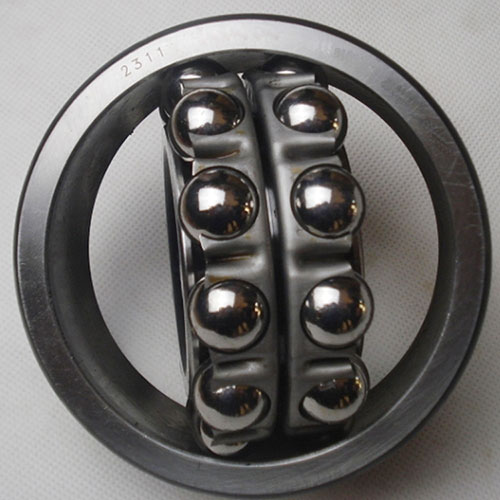
Self-aligning ball bearings are specially designed rolling bearings that can automatically compensate for shaft misalignment caused by installation errors, shaft deflection, or housing deformation. With a spherical outer ring raceway, these bearings allow the inner ring, balls, and cage to adjust their position while maintaining smooth rotation and reliable performance.
Due to their excellent alignment capability and low friction characteristics, self-aligning ball bearings are widely used in electric motors, conveyors, agricultural machinery, fans, mining equipment, and other industrial applications where accurate shaft alignment is difficult to maintain.
JYHY Group supplies a wide range of self-aligning ball bearings including different series, bore designs, and cage configurations for various operating conditions.
What Are Self-Aligning Ball Bearings?
A self-aligning ball bearing is a type of rolling bearing consisting of an inner ring, outer ring, rolling balls, and cage. Unlike standard deep groove ball bearings, the outer ring of a self-aligning ball bearing has a spherical raceway that allows the inner ring and rolling elements to tilt slightly.
This unique structure enables the bearing to compensate for angular misalignment between the shaft and housing, reducing additional stress and improving equipment reliability.
How Do Self-Aligning Ball Bearings Work?
During operation, shaft deflection or mounting errors may cause the shaft and housing centerlines to become misaligned. In conventional bearings, this condition can increase vibration, heat generation, and premature wear.
The spherical outer raceway of a self-aligning ball bearing allows the inner ring assembly to automatically adjust its position. This self-correcting function helps maintain smooth rolling contact and extends bearing service life.
Types of Self-Aligning Ball Bearings
Self-aligning ball bearings are available in several designs depending on mounting requirements and operating conditions.
Open Self-Aligning Ball Bearings
Open bearings are commonly used in clean environments where lubrication can be supplied externally. They provide low friction and are suitable for high-speed applications.
Sealed Self-Aligning Ball Bearings
Sealed versions use rubber seals to prevent contamination and retain lubricant. They are suitable for dusty or maintenance-restricted environments.
Cylindrical Bore and Tapered Bore Designs
Self-aligning ball bearings are available with cylindrical bores for standard shaft mounting and tapered bores for applications requiring adapter sleeves or easier installation.
Self-Aligning Ball Bearing Series
Different bearing series provide different dimensions, load capacities, and application advantages. Common self-aligning ball bearing series include:
| Series | Features | Typical Applications |
|---|---|---|
| 1200 Series | Compact design with standard load capacity | Electric motors, fans, general machinery |
| 1300 Series | Higher load capacity compared with 1200 series | Industrial equipment and transmission systems |
| 2200 Series | Wider inner ring design for improved support | Conveyors, agricultural machinery |
| 2300 Series | Larger dimensions and higher load capacity | Heavy-duty industrial applications |
Self-Aligning Ball Bearings Specifications
When selecting a self-aligning ball bearing, engineers should consider dimensions, load ratings, speed requirements, and operating conditions.
| Specification | Description |
|---|---|
| Bore Type | Cylindrical bore or tapered bore |
| Cage Material | Steel cage, polyamide cage, or brass cage depending on application requirements |
| Load Capacity | Designed mainly for radial loads with limited axial load capability |
| Misalignment Capability | Compensates for angular shaft misalignment |
| Lubrication | Grease or oil lubrication depending on operating conditions |
Advantages of Self-Aligning Ball Bearings
- Automatic alignment: Compensates for shaft and housing misalignment.
- Low friction operation: Provides smooth rotation and reduced energy loss.
- Reduced vibration: Helps improve equipment stability.
- Long service life: Reduces stress caused by installation errors.
- Easy installation: Suitable for applications where precise alignment is difficult.
Applications of Self-Aligning Ball Bearings
Self-aligning ball bearings are widely used in industries where operating conditions may cause shaft misalignment.
- Electric Motors: Maintain stable operation despite shaft deflection.
- Conveyor Systems: Support reliable material handling equipment.
- Agricultural Machinery: Adapt to variable working conditions.
- Mining Equipment: Provide reliable performance in harsh environments.
- Fans and Blowers: Ensure smooth high-speed rotation.
- Textile Machinery: Reduce vibration and improve precision.
- Industrial Drives: Handle alignment errors in rotating systems.
Self-Aligning Ball Bearings vs Deep Groove Ball Bearings
Both self-aligning ball bearings and deep groove ball bearings are widely used in industrial equipment, but they are designed for different operating conditions.
| Feature | Self-Aligning Ball Bearings | Deep Groove Ball Bearings |
|---|---|---|
| Alignment Capability | Excellent compensation for shaft misalignment | Requires accurate alignment |
| Main Load | Radial loads and light axial loads | Radial and moderate axial loads |
| Typical Applications | Conveyors, motors, agricultural machinery | Motors, pumps, general machinery |
For applications where shaft alignment cannot always be guaranteed, self-aligning ball bearings provide a more reliable solution.
How to Select Self-Aligning Ball Bearings?
Choosing the correct self-aligning ball bearing requires consideration of several important factors:
- Load requirements: Determine radial and axial loads during operation.
- Speed requirements: Select suitable bearing design and lubrication method.
- Mounting conditions: Choose cylindrical or tapered bore according to installation requirements.
- Operating environment: Consider sealing, contamination, and temperature conditions.
- Service life requirements: Select appropriate bearing size and load rating.
Self-Aligning Ball Bearings Manufacturer
JYHY Group provides industrial bearing solutions including self-aligning ball bearings for global customers. Our bearing products are manufactured with strict quality control to ensure dimensional accuracy, reliable performance, and consistent operation.
With experience in industrial bearing applications, we support customers in selecting suitable bearing designs for motors, conveyors, mining equipment, and other rotating machinery.
FAQ
What are self-aligning ball bearings used for?
Self-aligning ball bearings are used in electric motors, conveyors, agricultural machinery, fans, mining equipment, and other applications where shaft misalignment may occur.
How much misalignment can a self-aligning ball bearing handle?
The allowable misalignment depends on bearing design and operating conditions, but these bearings are specifically designed to compensate for angular alignment errors.
What is the difference between 1200 and 1300 series self-aligning ball bearings?
The 1300 series generally has larger dimensions and higher load capacity compared with the 1200 series, making it suitable for more demanding applications.
Can self-aligning ball bearings handle axial loads?
Yes. They can support light axial loads in addition to radial loads, but they are mainly designed for radial load applications.
Are self-aligning ball bearings suitable for high-speed applications?
Yes. Their low friction design allows them to operate efficiently in many high-speed applications when properly selected.
Need help selecting the right bearing? Browse our self-aligning ball bearings catalog or contact our technical team for professional bearing solutions.