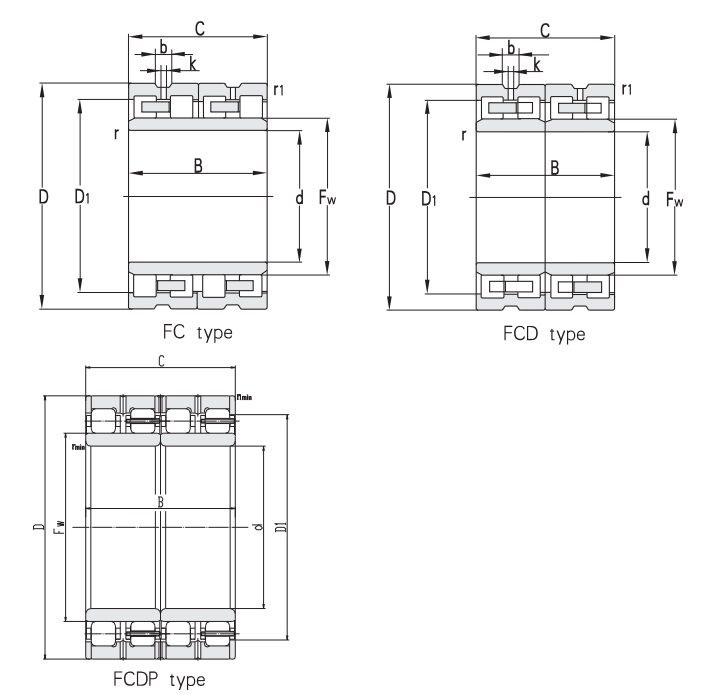
FC, FCD and FCDP are the three mainstream four-row cylindrical roller bearing types specially engineered for metallurgical rolling mill roll necks. All deliver ultra-high radial load capacity, yet their internal structure, assembly design and applicable working conditions vary greatly. This guide breaks down their core distinctions, interchange limits and ideal usage scenarios.
Quick Selection Guide by Operating Condition
1. Core Structural Differences Between FC, FCD, FCDP
| Bearing Model Type | Inner Ring Structure | Outer Ring Layout | Auxiliary Spare Parts | Standard Cage Style |
|---|---|---|---|---|
| FC | 1 solid integrated single inner ring | 2 separate outer rings (2 roller rows per outer ring) | No extra middle spacer or side retaining rings | Precision machined solid brass cage |
| FCD | 2 split independent inner rings | 2 separate outer rings (same as FC outer ring design) | No independent middle spacer; axial limit via ring integral ribs | Brass machined cage or stamped steel cage |
| FCDP | 2 split independent inner rings (same as FCD) | 2 outer rings without integral middle ribs | Equipped with 1 central spacer + two side flat retaining rings | Pin-type through bolt cage (max roller filling rate) |
FC Type Bearings
Key Advantages
- Monolithic inner ring brings excellent overall rigidity
- Highest allowable rotating speed among three series
- Fast mounting & dismounting for quick roll change
- Wide interchangeability for standard mill sizes
Limitations
Difficult for ultra-large forging production; slightly weaker shock resistance vs FCD/FCDP
Typical Applications
Small-medium bore sizes (80–260mm), cold mill work rolls, high-speed wire rod finishing mills
FCD Type Bearings
Key Advantages
- Split inner rings fit larger roll neck dimensions easily
- Balanced performance of speed and heavy load capacity
- Better anti-shock performance than FC bearings
- Medium production cost for large mill specifications
Limitations
More assembly steps than FC; speed rating lower than solid inner ring FC design
Typical Applications
Medium-large bore (260–400mm), section steel rough/finishing mills, medium cold mill backup rolls
FCDP Type Bearings
Key Advantages
- Highest radial load capacity of three series
- Full separable components for easy deep cleaning & maintenance
- Pin cage holds more rollers for extreme heavy impact loads
- Optimized for extra-large heavy-duty roll necks
Limitations
Most component parts; highest manufacturing cost; lowest maximum rotating speed
Typical Applications
Extra-large bore (≥390mm), hot strip mill backup rolls, heavy plate rolling mills, severe impact metallurgical lines
2. Interchange & Matching Notes
Critical Reminder: Same numerical size codes do NOT mean direct interchange. Internal ring structure differs fundamentally:
- It cannot be replaced by same-size numbered FCD or FCDP bearings due to mismatched roll neck fitting geometry.
- FCD and FCDP share split inner ring structure, but spacer & rib layout stops free direct swap without mechanical modification.
- Always confirm roll neck dimension, load level and speed before selecting FC / FCD / FCDP models.
3. Frequently Asked Questions About FC/FCD/FCDP Bearings
Browse our complete bearing series:
FC Series Bearings FCD Series Bearings FCDP Series Bearings All Multi-Row Bearings All Cylindrical Roller Bearings